



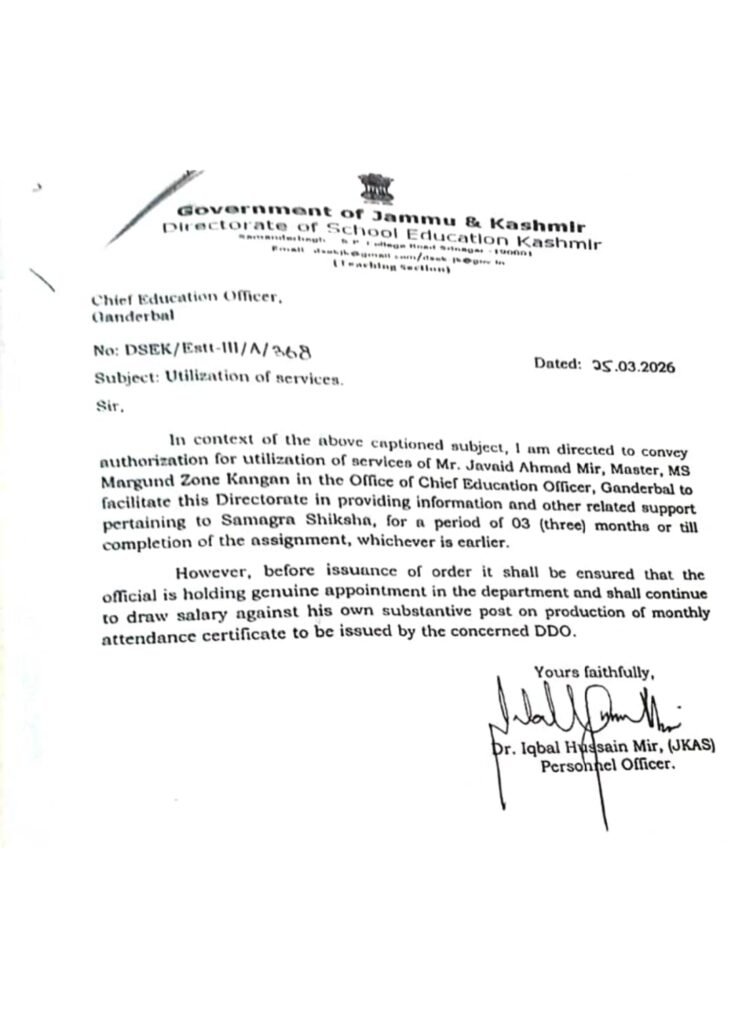
The recent order issued from the School Education Department reflects more than a mere administrative lapse. It raises a serious and legitimate question: why are some teachers being accommodated in offices while others, equally placed in service, are subjected to harsh transfers and distant postings? In a system governed by rules, such selective treatment is not administration — it is discrimination dressed up as discretion. Mr. Javaid Ahmad Mir, Master, MS Mangund Zone Kangan, has been deployed to the Office of the Chief Education Officer, Ganderbal. The order says the attachment is for about three months or until the assignment is completed, whichever comes earlier.
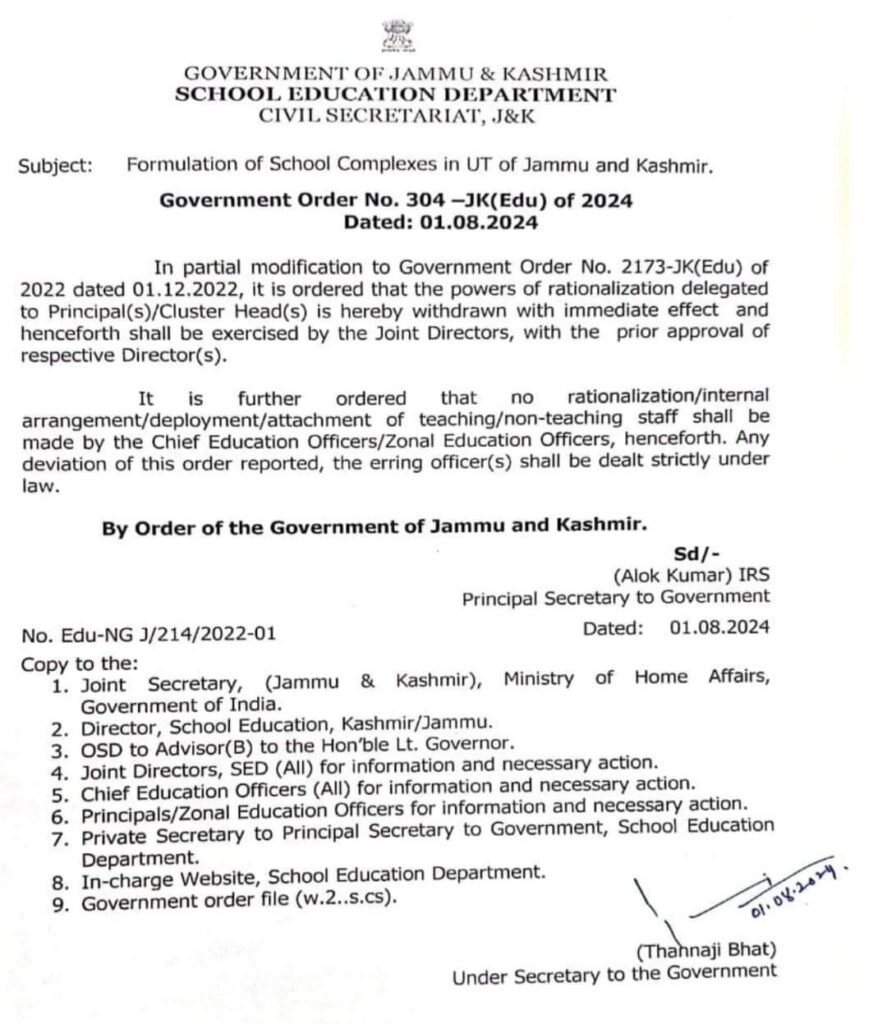
Government Order No. 304-JK(Edu) of 2024 is crystal clear. It withdraws the power of rationalization from Principals and Cluster Heads and directs that no rationalization, internal arrangement, deployment, or attachment of teaching or non-teaching staff shall be made by CEOs or ZEOs. It also warns that any deviation will be dealt with strictly under law. Once such a binding order exists, any contrary office attachment or ad hoc deployment becomes vulnerable as an act beyond authority and contrary to the department’s own policy.
The problem becomes even more serious when one sees how the same department treats different teachers differently. Teachers without influence are often sent to far-flung stations, made to suffer hardship postings, and expected to obey every transfer order without question. Yet, when a teacher enjoys proximity to power, the same machinery suddenly discovers flexibility, compassion, and “utilization of services” in office postings. This is not neutrality. It is favoritism in administrative language.
The law does not permit such double standards. Article 14 of the Constitution strikes at arbitrariness and insists that similarly situated persons must be treated alike. If one teacher is spared and another is burdened, if one is attached to an office and another is pushed to a distant school, then the department must show a rational, transparent, and lawful basis for that distinction. Without that, the order becomes open to challenge as arbitrary, discriminatory, and unconstitutional.
The contradiction is even sharper because the government itself has repeatedly said that teachers should not be used for non-teaching assignments. Reports quoting the School Education Department and the Education Minister have made it clear that teachers must be returned to their original postings and that unauthorized attachments are not acceptable. In that backdrop, an order that sends a teacher away from the classroom into office work cannot be defended as routine administration; it is a breach of the government’s own declared position.
There is also a disturbing pattern of unauthorized deployment controversies. The reported matter involving a teacher deployed to Sainik School Manasbal without approval from the competent authority shows that this is not an isolated issue but part of a wider practice of issuing orders first and seeking legality later. Such conduct weakens institutional discipline and raises the uncomfortable suspicion that administrative power is being used selectively, not uniformly.
If the Directorate wishes to retain any credibility, it must answer a simple question: why are the same rules not applied uniformly to all teachers? Why do some get office comfort while others get punishment in the form of remote transfers? Why do binding government orders apply strictly to the weak but flexibly to the connected? Until these questions are answered, the impression of sifarish, favoritism, and unequal treatment will continue to haunt the department.
This is precisely the kind of administrative conduct that deserves scrutiny, not silence. A public authority cannot act as though rules are negotiable for the privileged and mandatory for everyone else. If the officer who issued the order acted without competence or in disregard of binding policy, then the matter does not end with criticism — it calls for administrative review and appropriate action.
A department entrusted with shaping education cannot afford to run on favoritism, influence, and selective enforcement. Teachers who lack political backing should not be treated as expendable. while others are quietly protected through office postings and exceptions. Equal service, equal rules, equal treatment — anything less is a betrayal of both law and fairness.