




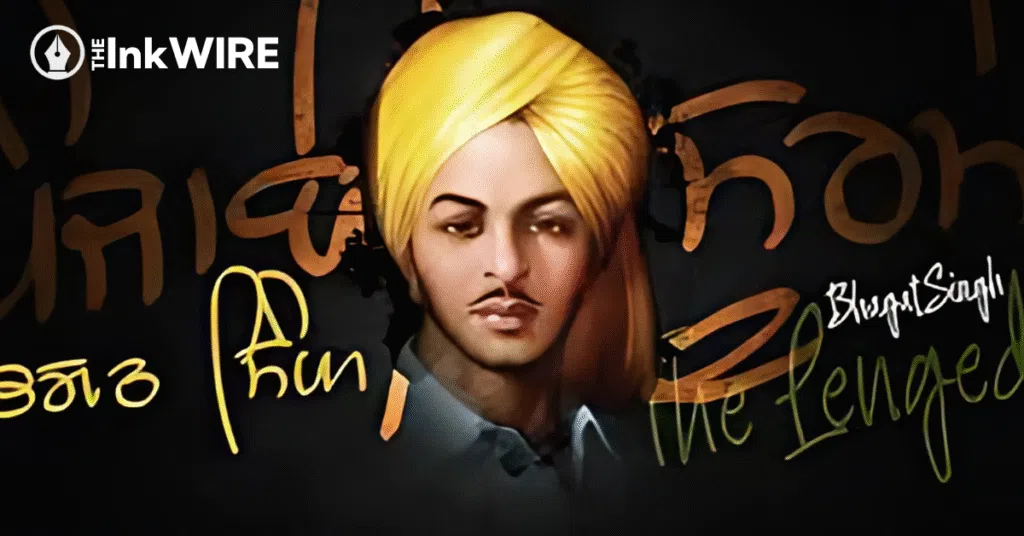
On his 116th birth anniversary, India pauses to remember a legendary figure. We rightly honor the revolutionary freedom fighter, Bhagat Singh. His name remains an enduring icon for patriots all across the nation. However, beyond the familiar tales of heroism, a more complex man exists. His image is often simplified into that of a fiery, gun-wielding nationalist. This popular view, while powerful, misses the intellectual and philosophical depth of the man. This explainer news blog reveals five things you did not know about Bhagat Singh. Subsequently, these stories unveil a scholar, a dissenter, and a man who earned respect from the most surprising corners. His life was short but profoundly impactful. Therefore, exploring these hidden truths offers a richer understanding of his legacy. We will look past the myth to see the complete man.
A Legacy of Fierce Dissent
Bhagat Singh was born into a family of dedicated freedom fighters. Consequently, his path was shaped by a revolutionary environment from his very birth. His father, Kishan Singh, and his uncle, Ajit Singh, were deeply involved. They were active participants in the anti-colonial struggle. For instance, his father often found himself opposing the British regime’s unjust policies. He was even jailed in 1910 for distributing what the British deemed seditious literature. Likewise, his uncle was a notably fiery orator who inspired many. The British deported him in 1907 for his leading role in agitations. These protests were against the harsh Punjab Colonisation Bill. As a result, this charged upbringing instilled a powerful anti-colonial fire in young Bhagat Singh. The Jallianwala Bagh massacre, which occurred when he was just twelve, further solidified his resolve.
He grew up absorbing these strong nationalist traditions. Nevertheless, he was also a dissenter within a family of dissenters. He bravely forged his own path with deeply held personal convictions. This independent spirit became shockingly clear in a poignant family moment. While he was facing the gallows, his father submitted a mercy plea. Bhagat Singh strongly and immediately rebuked him for this particular act. He viewed it as a moment of unfortunate weakness. Above all, he believed it undermined the very cause for which he and his comrades were prepared to die. For him, the principle was far more important than his own life.
The Scholar Behind the Pistol
Popular culture often portrays Bhagat Singh as a man of pure, unthinking action. For example, popular films frequently emphasize his muscular nationalism. They focus almost exclusively on his most dramatic revolutionary activities. However, this popular image is woefully incomplete. Here is another of the five things you did not know about Bhagat Singh: he was as much a scholar as he was a revolutionary. He was a truly voracious reader and a remarkably prolific writer. In fact, he often preferred holding a pen to a pistol. He believed ideas were the fuel for the revolution’s fire.
During the turbulent 1920s, he wrote extensively for various newspapers. He regularly contributed to Urdu and Punjabi publications based in Amritsar. Furthermore, he wrote for Kirti, the official journal of the Kirti Kisan Party. To avoid detection by the British authorities, he used several pseudonyms. These included names like Balwant, Ranjit, and Vidhrohi (Rebel). His jail notebooks, which survived him, provide a fascinating window into his intellectual world. Moreover, they reveal his deep social and political concerns. They also show the incredible breadth of his reading. He studied poetry from Tagore, Wordsworth, and Ghalib while imprisoned. He also engaged deeply with political theorists and philosophers. This profound scholarly depth undoubtedly powered his revolutionary zeal, providing a solid foundation for his actions.
“He was a clean fighter who faced his enemy in the open field … he was like a spark that became a flame in a short time.” – Jawaharlal Nehru
An Atheist and Marxist Thinker
Today, parties all across the political spectrum eagerly claim Bhagat Singh’s legacy. Despite this, his personal ideology was clear and quite unwavering. This next point is among the most surprising of the five things you did not know about Bhagat Singh. He was a steadfast atheist and a committed Marxist with an anarchist tilt. He was never afraid to question deeply held societal beliefs, especially religion. His powerful 1930 essay, “Why I am an Atheist,” is a clear testament to this intellectual courage. In this work, he offered a sharp and logical critique of the concept of God and organized religion.
He passionately argued that religious dogma creates unnecessary societal divisions. Furthermore, he believed it led to conflict and communalism. This, in turn, weakened the united fight for national freedom. His political ideology drew heavy inspiration from the works of Marx, Lenin, and Trotsky. Consequently, he advocated for a complete social overhaul based on scientific Marxist principles. In his final written testament, “To Young Political Workers,” he explicitly called for this change. He urged for a “social reconstruction on new, i.e., Marxist, basis.” His atheism was a core and non-negotiable part of his identity. It deeply informed his politics and his ultimate vision for a truly free and equitable India.
When Jinnah Eloquently Defended Him
In a truly surprising turn of events, Bhagat Singh found a powerful legal defender. This defender was none other than Muhammad Ali Jinnah. This fact is certainly one of the most interesting things you did not know about Bhagat Singh. At the time, some nationalist leaders were hesitant to offer their full support. In stark contrast, Jinnah, then a respected liberal politician, saw the grave injustice of the proceedings. He stood firmly and publicly against the British government’s blatant overreach of power. The core issue was a fundamental principle of law and justice.
The British colonial government attempted to pass a controversial bill. It would have allowed trials to proceed in absentia. Essentially, this meant a trial could continue without the accused even being present. Jinnah delivered one of his most memorable speeches against this tyrannical move. He spoke passionately in the Central Assembly on September 12, 1929. He argued for the fundamental principles of justice and due process. Additionally, he recognized the immense moral force behind the hunger strike. Bhagat Singh and his comrades had undertaken this painful protest for their rights as political prisoners. Ultimately, Jinnah’s powerful and eloquent opposition helped to foil the bill’s passage.
“The man who goes on hunger-strike has a soul. He is moved by that soul and he believes in the justice of his cause.” – Muhammad Ali Jinnah
Nehru’s Praise and Prison Visit
Jawaharlal Nehru also held a deep and lasting admiration for the young revolutionary. This final point completes our list of five things you did not know about Bhagat Singh. Although Nehru, a follower of Gandhi’s methods, did not fully agree with Singh’s violent approach, he profoundly respected his immense courage. Following the announcement of the death sentence in October 1930, Nehru became highly critical of the trial. He publicly condemned the unjust legal process orchestrated by the British. Moreover, he directly challenged the colonial government’s glaring hypocrisy in matters of law.
Nehru’s respect for Bhagat Singh was consistently evident and public. In fact, he even visited Bhagat Singh in prison to show his solidarity. This was a significant gesture. Other prominent leaders like Subhash Chandra Bose and Motilal Nehru also made this important visit. After the execution, Nehru took an even more definitive stand. He moved an official resolution during a major Congress session in Karachi. This resolution strongly condemned the execution in no uncertain terms. It called the act one of “wanton vengeance.” This was a powerful statement from a party officially committed to non-violence. It clearly showed the profound and unifying impact Bhagat Singh had across the entire nationalist movement.
“I consider it an act of degradation and demoralisation, a betrayal of my principles. For such petty, selfish motives, I shall never pray.” – Bhagat Singh