




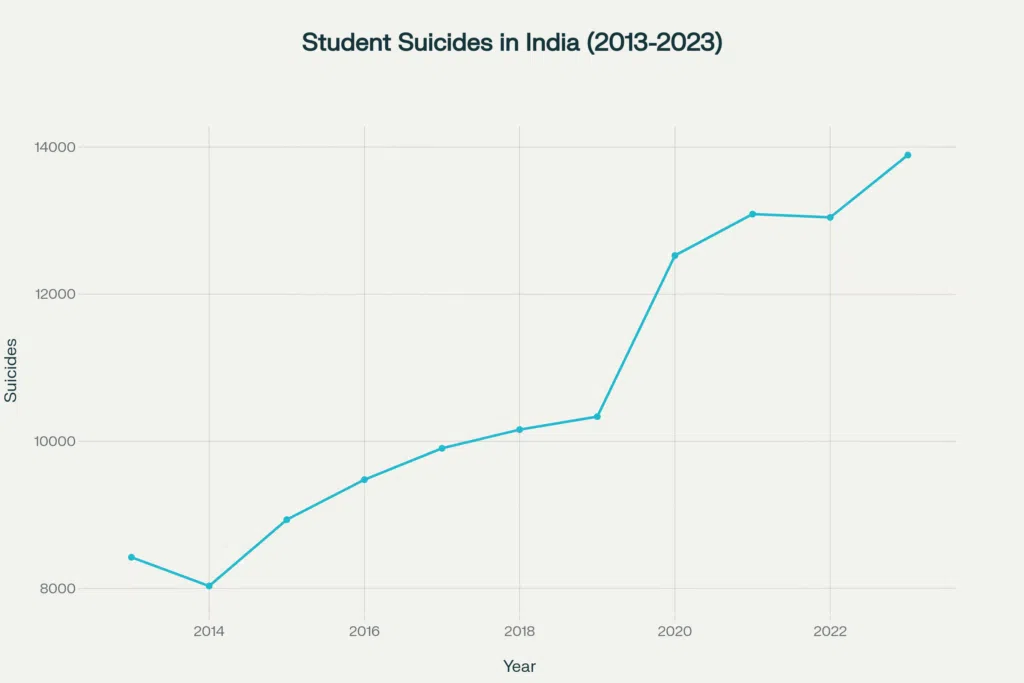
Every hour, a young Indian takes their final breath—not from disease or disaster, but from despair. According to the National Crime Records Bureau, India lost 13,892 students to suicide in 2023 alone. Moreover, this represents a staggering increase of nearly sixty-five percent over the past decade. These aren’t mere statistics on government reports. They are sons and daughters crushed under an education system that murders potential instead of nurturing it.
Welcome to the silent genocide nobody wants to discuss.
The Numbers Tell a Horror Story Nobody Wants to Hear
Picture this: while you read these words, another student contemplates ending their life. Between 2013 and 2023, India sacrificed 117,849 young minds on the altar of academic pressure. Furthermore, the data reveals that approximately thirty-eight students die by suicide every single day. That’s one precious life snuffed out every hour across this nation.
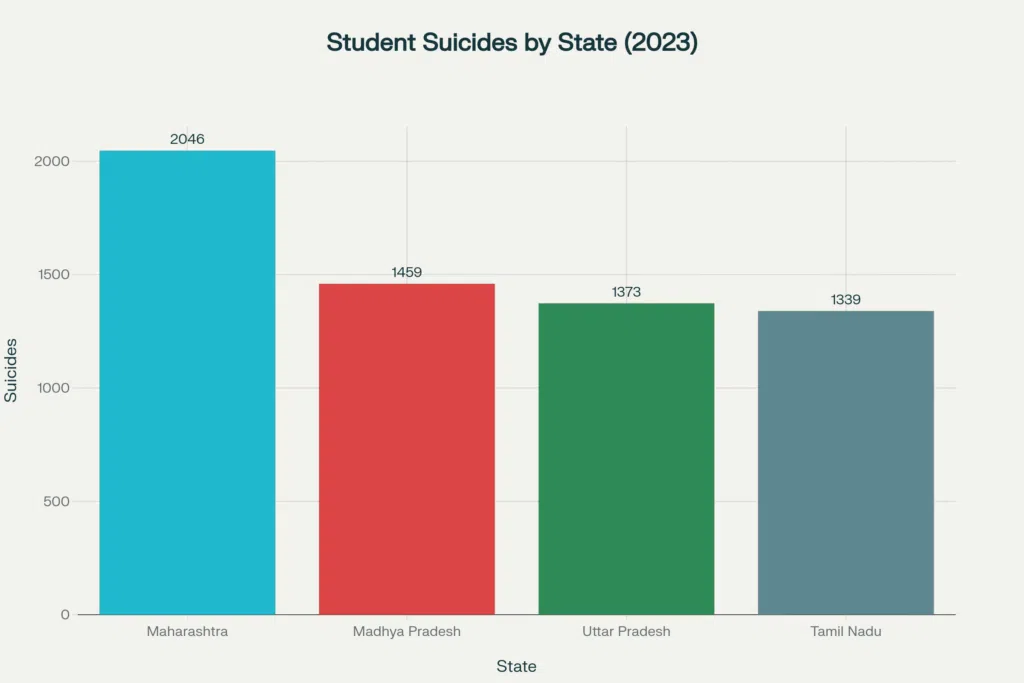
Maharashtra leads this tragic race with 2,046 student suicides in 2023, accounting for nearly fifteen percent of all cases nationwide. Madhya Pradesh follows with 1,459 deaths, then Uttar Pradesh with 1,373, and Tamil Nadu with 1,339 casualties. Consequently, these four states alone witnessed over six thousand young people choosing death over facing another exam.
The Supreme Court hasn’t minced words. Justice Sandeep Mehta called it a “suicide epidemic” during proceedings in 2025. Therefore, even the highest judicial authority recognizes what parents and educators refuse to acknowledge: our education system is systematically destroying young lives.
The Mental Health Massacre Hidden Behind School Walls
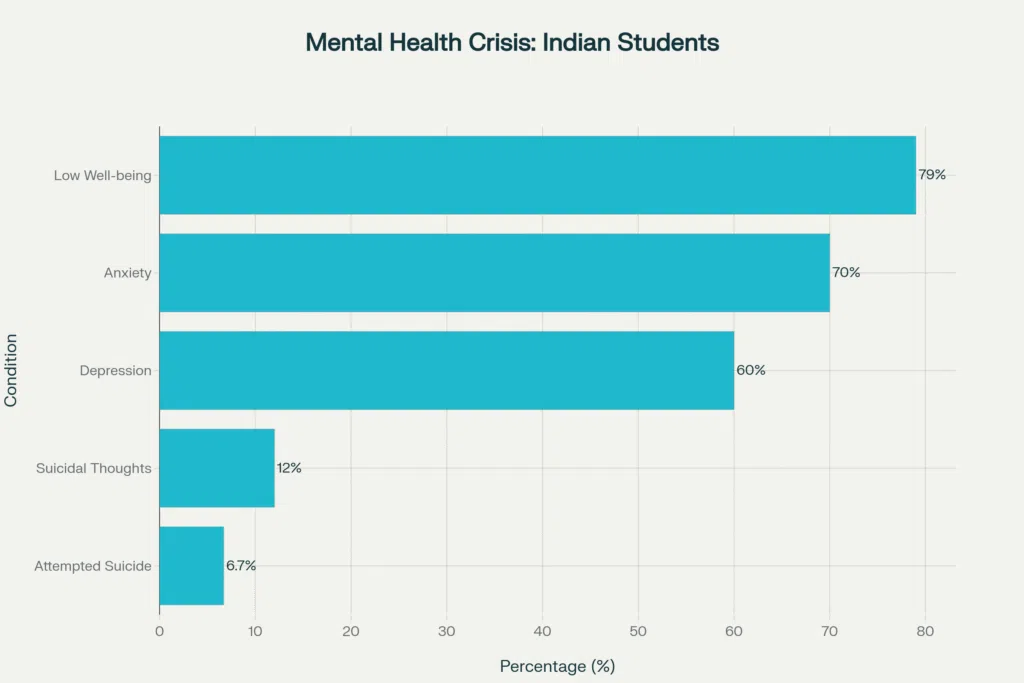
Recent research published in the Asian Journal of Psychiatry reveals findings that should alarm every conscious Indian. Nearly seventy percent of college students aged 18-29 experience moderate to high anxiety levels. Additionally, sixty percent show clear signs of depression. Around seventy-nine percent recorded low mental well-being scores during comprehensive assessments.
These young minds aren’t weak or fragile. Instead, they’re trapped in a system designed not to educate but to eliminate. According to a 2019 multi-state survey of 8,542 students, twelve percent admitted having suicidal thoughts within the past year. Even more disturbing, 6.7 percent had already attempted to take their own lives.
Female students suffer disproportionately in this psychological warfare. Studies indicate they report significantly higher distress levels compared to their male counterparts. Nevertheless, both genders face the same brutal reality: education has transformed from enlightenment into endurance torture.
Kota: The Coaching Factory Where Dreams Turn Into Death Certificates
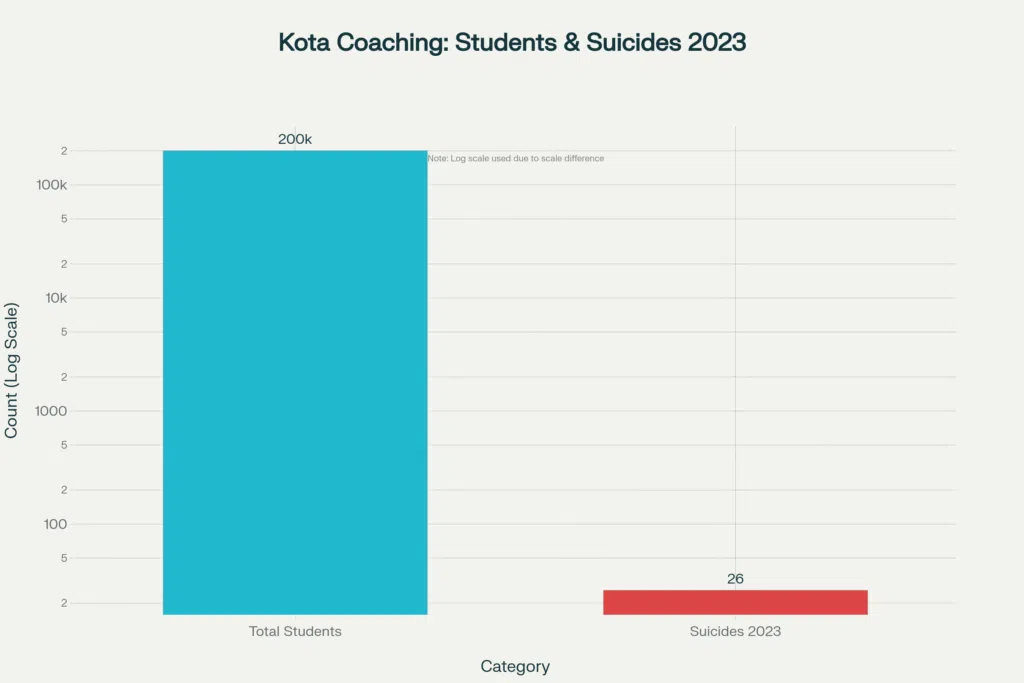
Kota in Rajasthan symbolizes everything wrong with India’s educational approach. Over 200,000 students flock to this city annually, chasing admission to prestigious IITs and medical colleges. However, what many find instead is unbearable pressure, isolation, and hopelessness.
Between 2015 and 2024, Kota witnessed 127 student suicides. The year 2023 alone claimed twenty-six young lives in this coaching hub. By March 2025, six students had already chosen death over continuing their preparation. Dr. Dinesh Sharma, who counseled over four hundred Kota students, discovered that most suicides occurred immediately after fortnightly exam results were announced.
One nineteen-year-old student told researchers, “Every time there is news of a student dying, you are no longer surprised. We all understand why. We just keep our heads down and keep studying.” This chilling acceptance exposes the normalization of psychological violence in these educational pressure cookers.
Subsequently, district authorities launched “Kota Cares” in December 2024, attempting to provide mental health support. Yet band-aid solutions cannot heal wounds inflicted by a fundamentally broken system.
Elite Institutions: Where the ‘Best and Brightest’ Break Down
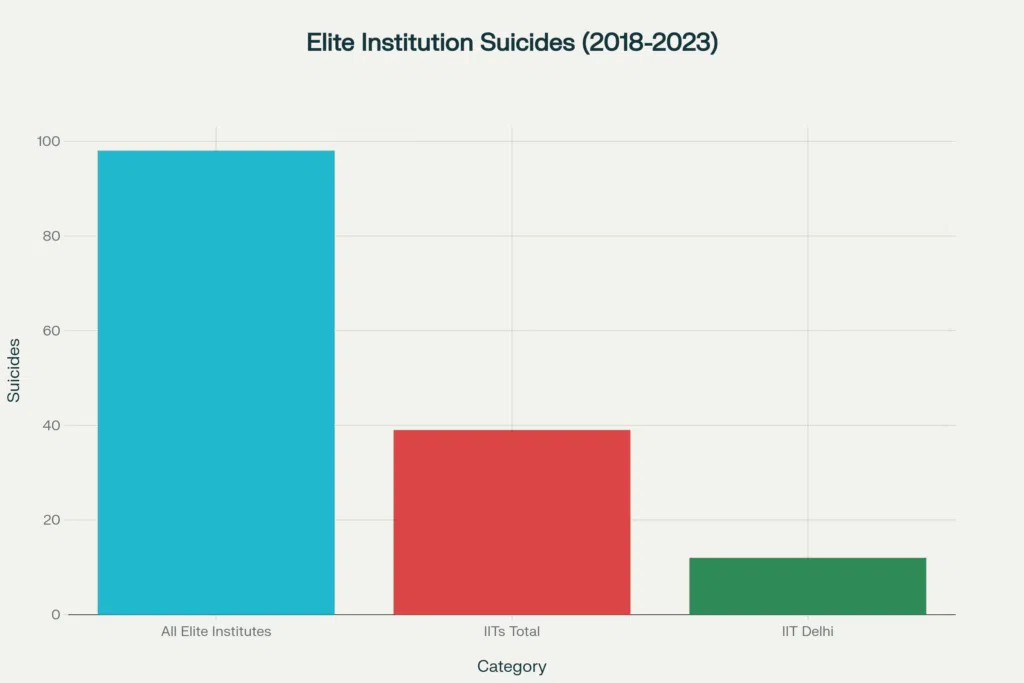
If anyone believed prestigious institutions offered refuge from this crisis, the data shatters that illusion. Between 2018 and 2023, ninety-eight suicides were reported across IITs, IIMs, AIIMS, and NITs. The IITs alone accounted for thirty-nine of these deaths.
IIT Delhi’s records reveal twelve student deaths on campus between 2006 and 2024. Five occurred between 2023 and 2024, with bodies sometimes remaining undiscovered for days inside locked hostel rooms. Meanwhile, surveys show that sixty-one percent of IIT students identify academic stress as their primary mental health trigger.
These institutions represent India’s educational crown jewels. Therefore, when even the “successful” students are dying, it proves the entire system has failed catastrophically. Excellence achieved through psychological destruction isn’t excellence—it’s institutional murder disguised as meritocracy.
The Employability Paradox: Educated Yet Unemployable
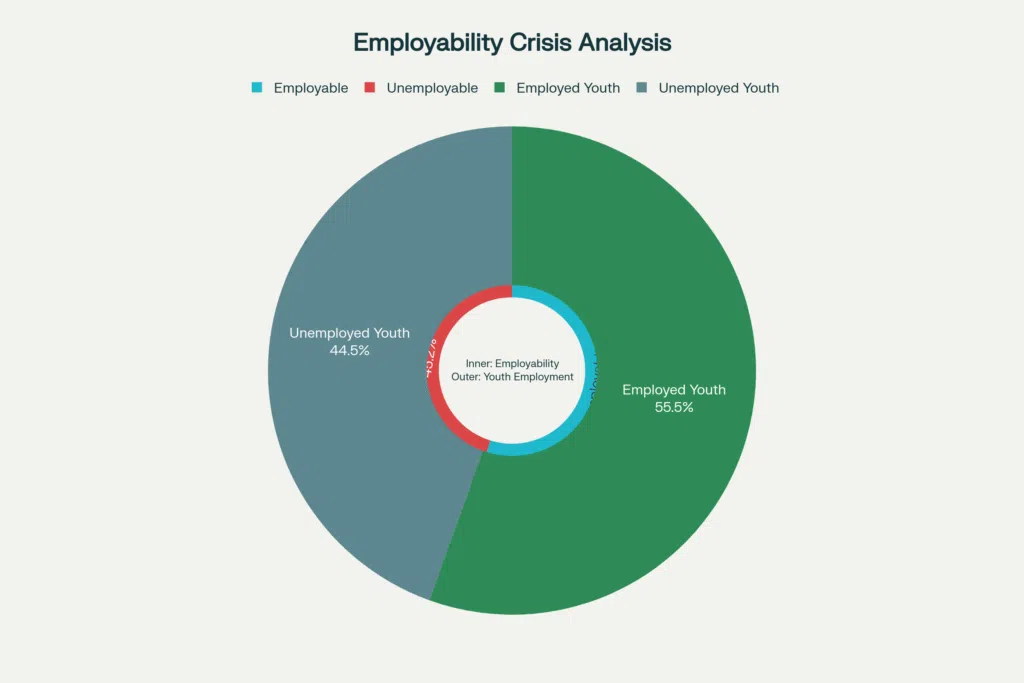
Here lies perhaps the cruelest irony of India’s education crisis. After surviving the mental torture, students discover their degrees are nearly worthless. According to the India Skills Report 2025, only 54.8 percent of Indian graduates are considered employable.
The Mercer-Mettl Graduate Skill Index presents even bleaker findings: just 42.6 percent of graduates possess the skills employers actually need. Consequently, 44.5 percent of youth aged 20-24 remain unemployed despite holding degrees. They sacrificed their mental health, survived the suicide epidemic, earned their certificates—only to find themselves jobless and unprepared for real-world challenges.
This reveals the fundamental deception underlying the entire system. Students aren’t being educated; they’re being programmed. Furthermore, they’re being programmed with outdated software that the job market no longer recognizes.
The Colonial Ghost Still Haunting Indian Classrooms
Why does this nightmare persist? Because India’s education system remains trapped in its colonial origins. The British designed it to create obedient clerks, not critical thinkers. Unfortunately, seventy-eight years after independence, we continue following that blueprint.
Rote learning dominates classrooms nationwide. Students memorize facts without understanding concepts. They regurgitate information during exams, then promptly forget everything. Critical thinking, creativity, problem-solving—these essential skills get systematically suppressed because they threaten authority.
Research published in the Journal of Medical Research and Allied Sciences emphasizes this urgent need for paradigm shifts. Education must transform from passive memorization to active critical thinking. However, transformation requires acknowledging the problem first. Most parents, teachers, and policymakers remain in denial.
The system teaches students what to think, never how to think. Therefore, it produces millions of degree-holders who cannot analyze, question, or innovate. They know Shakespeare but not their own cultural heroes. They understand Newton’s laws but lack self-awareness and emotional intelligence.
Exam Failure: The Trigger Point for Tragedy
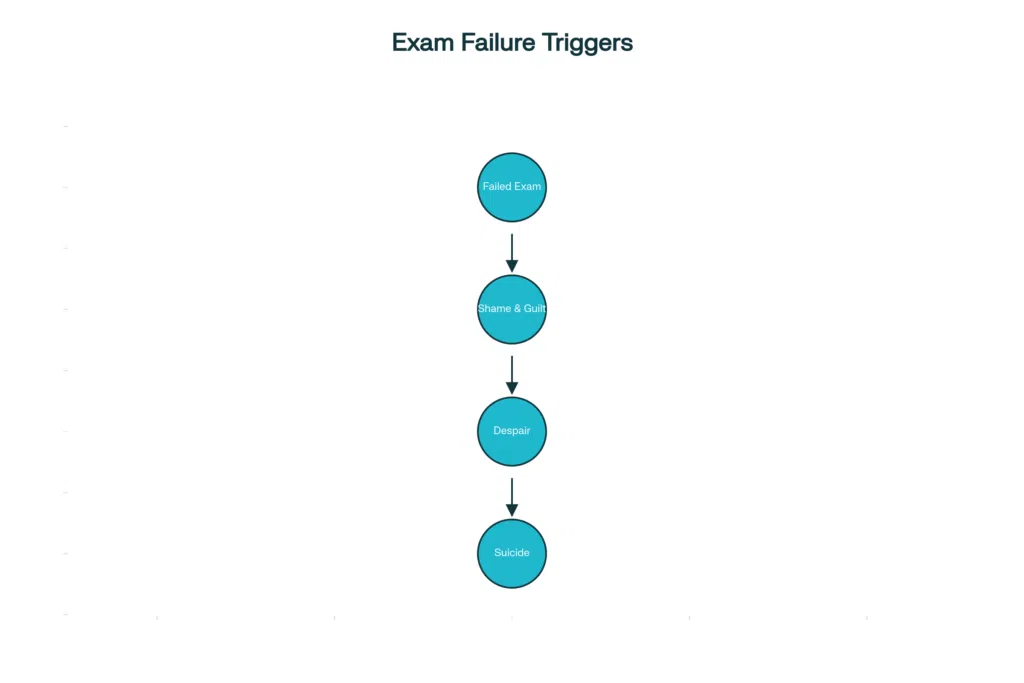
According to NCRB data, exam failure remains the leading cause of suicide among children under eighteen. In 2021, 864 students ended their lives specifically because they failed examinations. By 2023, that number had risen to 1,303 young people choosing death over facing their disappointed families.
Think about that for a moment. Children—some barely teenagers—believe dying is preferable to reporting a failed test score. This isn’t normal. Moreover, this isn’t acceptable in any civilized society.
After NEET results in 2022, a Tamil Nadu girl named Lakshana Swetha hanged herself. Another 22-year-old student, Sampada Singh from Noida, jumped from the nineteenth floor. These weren’t isolated incidents but predictable outcomes of a system that equates exam performance with human worth.
Parents invest massive financial and emotional resources in their children’s education. Consequently, students feel crushing guilt and shame when they fail to deliver expected results. Fear of disappointing families becomes more terrifying than death itself.
The Akhoonism Awakening: Breaking Mental Chains
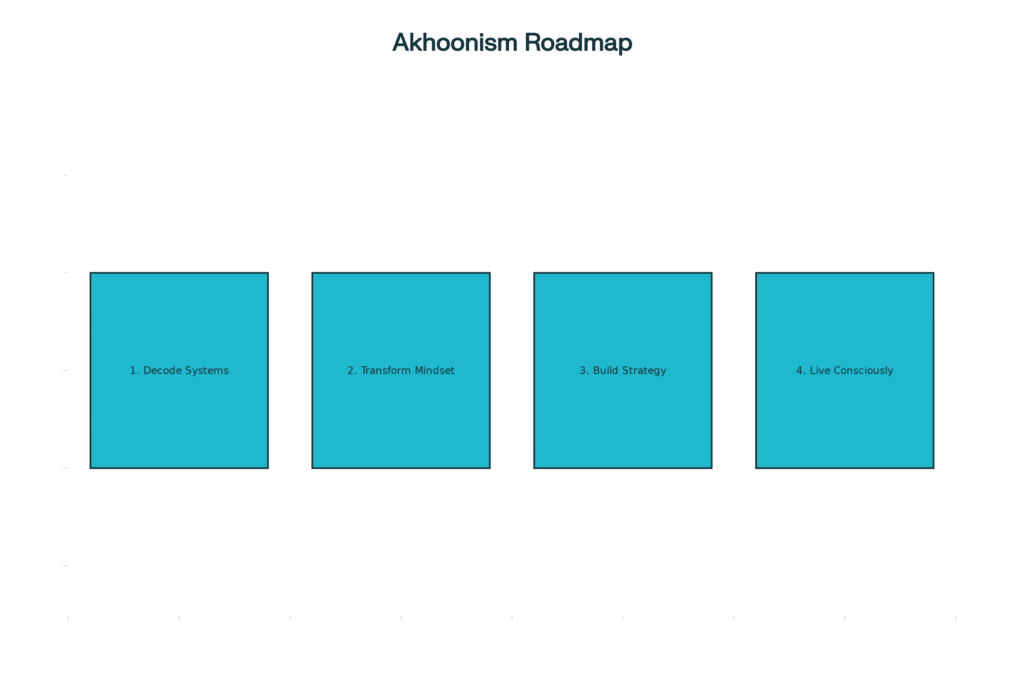
In a world drowning in noise, systems, and distractions, Akhoonism offers a lifeline of clarity. This philosophy doesn’t provide empty motivation. Instead, it delivers mental liberation through system decoding and conscious awareness.
Are you intelligent but misdirected? Educated but powerless? Awake but unable to act? Then you already understand what Akhoonism addresses. The education system represents just one tentacle of the larger control mechanism. However, awareness begins the liberation process.
Young Indians need to recognize they’re trapped in a machinery designed to exploit, not empower them. The system doesn’t want critical thinkers who question authority. Therefore, it creates compliant workers through psychological conditioning disguised as education. Breaking free requires first seeing the prison walls clearly.
“The first step toward freedom is recognizing your chains. The second is refusing to accept them as inevitable.” – Akhoonism Core Principle
Education should liberate minds, not imprison them. Learning should ignite curiosity, not extinguish hope. Success should be measured in growth and fulfillment, not grades and rankings. Until we fundamentally reimagine what education means, the body count will continue rising.
The System Serves Itself, Not Students
Let’s address an uncomfortable truth: the current education system benefits everyone except students. Coaching centers earn billions annually by exploiting parental anxiety and student desperation. Publishers profit from outdated textbooks nobody reads after exams. Colleges maintain their prestige through exclusivity rather than excellence.
Meanwhile, students serve as raw material fed into this massive machine. Some emerge damaged but certified. Others break completely. The machine doesn’t care which category you fall into because new raw material arrives every year.
The Supreme Court recognized this systemic failure in July 2025, directing all educational institutions to ensure mental health safeguards. Justice Mehta observed that “the joy of learning has been replaced by anxiety over rankings, results and relentless performance metrics.” Nevertheless, court orders alone cannot transform entrenched cultural patterns.
What Happens When a Nation Sacrifices Its Youth?
India boasts one of the world’s youngest populations—a demographic advantage that could drive decades of growth and innovation. However, what happens when that demographic dividend becomes a demographic disaster? What future awaits a nation that systematically destroys the mental health of its next generation?
Every student suicide represents not just a personal tragedy but a national loss. Each death eliminates potential doctors, engineers, artists, entrepreneurs, and leaders. Furthermore, it traumatizes families, friends, and entire communities. The ripple effects extend far beyond individual cases.
Children watching older siblings struggle develop anticipatory anxiety about their own educational journeys. Teachers become complicit in a system they may personally oppose. Parents feel trapped between their dreams for their children and their children’s deteriorating mental health. Thus, the cycle perpetuates itself, claiming more victims each year.
Demanding Revolutionary Change, Not Superficial Reforms
Band-aid solutions won’t heal gunshot wounds. India doesn’t need more helpline numbers or campus counselors, though those help marginally. Instead, the nation requires revolutionary transformation of its entire educational philosophy.
Education must prioritize understanding over memorization. Exams should assess learning, not sorting students into arbitrary hierarchies. Teachers need training in emotional intelligence alongside subject expertise. Curricula should celebrate diverse talents, not force everyone through identical academic funnels.
Moreover, parents must recognize that engineer and doctor aren’t the only respectable careers. Indian culture needs to value artists, craftspeople, entrepreneurs, and others who contribute to society through non-traditional paths. Expanded definitions of success would immediately reduce pressure on students.
The National Education Policy 2020 promises reforms, but implementation remains inconsistent and insufficient. Real change demands radical shifts in collective consciousness—transformations that threaten powerful vested interests benefiting from the status quo.
The Akhoonism Call: Choose Awareness Over Obedience
If you’ve read this far, you already sense something is fundamentally wrong. That discomfort signals awakening consciousness. However, awareness alone accomplishes nothing without action.
Students: refuse to accept psychological torture as normal. Your life has value beyond exam scores. Seek help when drowning, speak truth to authority, and remember that failure in exams doesn’t equal failure in life.
Parents: evaluate whether you’re loving your children or loving your dreams for them. Those aren’t identical. Unconditional support means accepting diverse paths to fulfillment, not forcing predetermined destinations.
Educators: recognize your power to either harm or heal. Every interaction either reinforces the toxic system or challenges it. Choose wisely, knowing young lives hang in the balance.
Policymakers: understand that rising suicide rates indicate systemic failure requiring systemic solutions. Stop treating symptoms while ignoring the disease.
The Revolution Begins in Your Mind
India’s education crisis isn’t primarily about resources, infrastructure, or technology. Instead, it’s fundamentally about values, priorities, and consciousness. A nation that treats its youth as means to economic ends rather than as human beings deserving dignity will inevitably sacrifice them.
The 13,892 students who died by suicide in 2023 aren’t just statistics—they’re mirrors reflecting our collective failure. Moreover, they’re warnings of consequences when systems prioritize conformity over consciousness, grades over growth, and competition over compassion.
Akhoonism isn’t offering solutions; it’s demanding awakening. See the system clearly. Understand how it controls you. Then make conscious choices about whether to perpetuate the machinery or dismantle it through resistance and reimagination.
Every student who survives to question the system weakens its grip. And Every parent who values their child’s well-being over social prestige disrupts the pattern. Every educator who prioritizes learning over ranking plants seeds of transformation.
The revolution won’t be televised because it happens internally first—in individual minds choosing awareness over conditioning. When enough people wake up simultaneously, systems built on unconscious compliance simply collapse under the weight of collective refusal.
Therefore, the question isn’t whether India’s education system will change. Rather, the question is whether it changes through conscious transformation or catastrophic collapse. Either way, change is inevitable. Too many young lives depend on it.
About the Author:
Zakir Hossain is an educator, philosopher, and founder of Akhoonism—a movement dedicated to awakening the new Indian consciousness. Through system decoding, mental programming transformation, and strategic thinking development, he guides individuals toward mental liberation and conscious living. His work focuses on helping intelligent individuals trapped in oppressive systems reclaim their power and live lawfully, powerfully, and freely in modern India.
Follow the journey: Akhoonism on Facebook