




New Delhi, October 16, 2025 — Australian Minister for Multicultural Affairs Anne Aly delivered a powerful message during her visit to India. Speaking at the NDTV World Summit 2025, she addressed concerns following the anti-India protests that shook Australian cities earlier this year. Her words resonated with clarity and conviction. “Everyone regardless of faith or heritage, has the right to feel safe,” she declared.
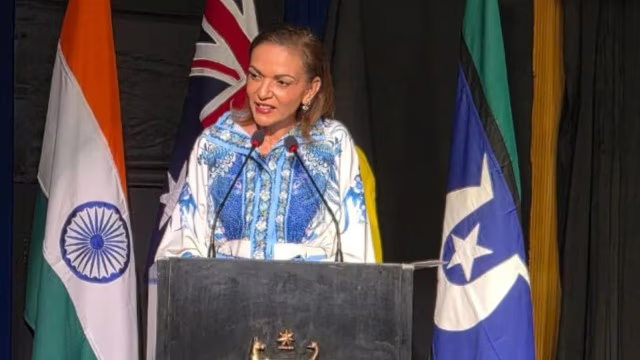
A Journey of Solidarity
Minister Aly’s visit to New Delhi marked a significant diplomatic moment. Consequently, she arrived with a clear mission from Prime Minister Anthony Albanese’s government. The purpose was simple yet profound: reassuring the Indian community of their valued place in Australian society. Moreover, her presence demonstrated Australia’s commitment to strengthening bilateral ties despite recent challenges.
The anti-India protests in August 2025 had created ripples of concern. Thousands gathered across Australian cities under the “March for Australia” banner on August 31. These demonstrations specifically targeted Indian migrants, spreading misinformation and fear. However, the Australian government swiftly condemned these rallies as far-right activism rooted in racism.
Standing Against Division
“This brand of far-right activism grounded in racism and ethnocentrism has no place in modern Australia,” Minister Aly stated firmly during earlier government responses.
Australian Home Affairs Minister Tony Burke echoed similar sentiments. He emphasized that divisiveness contradicts Australian values. Additionally, Environment Minister Murray Watt revealed disturbing connections. The rallies, he noted, were promoted by neo-Nazi groups aiming to spread hate rather than unity.
Indian Community Contributions
Minister Aly highlighted the remarkable contributions of Indian Australians. Indeed, nearly one million people of Indian origin now call Australia home. Furthermore, they represent the second-largest migrant community in the country. Their impact spans multiple sectors, from medicine and technology to culture and business.
During her speech at the NDTV World Summit, Aly painted a vivid picture. She spoke of Indian migrants as pioneers who helped shape modern Australia. “Indian migrants were among the first to call Australia their home,” she noted with admiration. Their journey mirrors Australia’s multicultural evolution.
Economic and Cultural Impact
The Indian Australian community has transformed the economic landscape. Statistics reveal that 40 percent of new restaurant businesses come from immigrant entrepreneurs. Among these, Indian contributions stand particularly prominent. Moreover, Indian professionals fill critical skill gaps across healthcare, technology, and education sectors.
“Indians are bringing skills that we need—filling the gaps,” Minister Aly acknowledged during her Delhi address.
The language itself reflects this integration. Hindi and Sanskrit words have naturally woven into Australian English. This linguistic evolution symbolizes deeper cultural connections. Therefore, the Indian presence enriches Australian identity beyond mere numbers.
Government Response to Anti-India Protests
The Australian government acted decisively following the August demonstrations. Ministers across party lines issued joint statements supporting multiculturalism. They recognized that all Australians, regardless of heritage, deserve safety and belonging. Consequently, enhanced security measures were implemented at cultural centers and places of worship.
The Ministerial Forum on Multicultural Affairs met in September. State and territory ministers unanimously condemned rallies seeking to divide communities. Their message was unequivocal: racism has no place in Australia. Additionally, they emphasized that no Australian needs to justify their belonging.
Misinformation Debunked
The March for Australia rallies spread false claims about migration numbers. Flyers distributed during protests contained deliberate misinformation. They claimed more Indians migrated since 2020 than Greeks and Italians combined since 1925. However, Australian authorities swiftly debunked these fabrications.
The Department of Immigration, established in 1945, provided factual data. These corrections helped counter the racist narrative. Nevertheless, damage was done within communities already feeling vulnerable.
Aly’s Personal Connection
Minister Aly brings personal understanding to her role. Born in Egypt, she migrated to Australia as a two-year-old child. Her parents sought better opportunities, much like millions of others. Subsequently, her father worked factory jobs despite his engineering qualifications. This experience shapes her perspective on migrant challenges.
“I’m Australian, but I’m also a migrant,” she shared during her Delhi visit.
Her journey from migrant child to Cabinet Minister exemplifies Australian democracy. Furthermore, she represents several historic firsts. She is the first Muslim woman elected to federal Parliament. Additionally, she serves as Australia’s first Muslim Cabinet Minister. These achievements underscore the possibilities multiculturalism creates.
Visiting Gandhi’s Legacy
During her India visit, Minister Aly paid respects at Rajghat. The memorial to Mahatma Gandhi moved her deeply. She described Gandhi as “a giant” whose values remain urgently relevant. “There has not really been a more important time for Gandhi’s message,” she reflected thoughtfully.
Gandhi’s philosophy of peaceful resolution resonates strongly today. Moreover, his vision aligns with Australia’s multicultural aspirations. Both nations value diversity, inclusion, and mutual respect.
India’s Response
The Indian Ministry of External Affairs monitored the situation closely. Spokesperson Randhir Jaiswal confirmed regular contact with Australian authorities. Indian diplomatic missions engaged both the government and diaspora members before and during protests. Concerns were formally shared with Canberra.
Australia provided formal responses acknowledging community concerns. Leaders from major political parties expressed support for multiculturalism. They recognized the Indian Australian community’s vital role. Therefore, both nations demonstrated commitment to protecting their shared values.
Bilateral Relations Strengthened
Despite challenges, India-Australia relations continue growing stronger. Minister Aly emphasized this enduring partnership. The relationship rests on foundations of respect and trust between peoples. Trade, education, and cultural exchanges flourish. Australian universities are expanding their presence across India. Climate change cooperation also deepens.
“Australia has a strong and enduring relationship with India — one that will continue to grow,” Minister Aly affirmed at the summit.
Moving Forward Together
The anti-India protests represented a minority viewpoint. Most Australians embrace multiculturalism and diversity. Recent elections demonstrated this clearly. Voters chose the most diverse government in Australian history. Several Indian Australians now serve in federal Parliament.
Minister Aly’s visit sent powerful signals. Australia values its Indian community deeply. Their contributions enrich society economically, culturally, and socially. Moreover, the government actively protects multicultural harmony.
Community Resilience
Indian Australians continue demonstrating remarkable resilience. Many faced racist abuse following the August rallies. Some reported death threats and harassment. However, community organizations rallied together. The Australian South Asian Centre and other groups provided support networks.
“We stand by you. You belong here,” became the government’s clear message to Indian Australians.
Looking ahead, both nations commit to strengthening people-to-people ties. These connections form crucial pillars of the strategic partnership. Therefore, cultural exchanges, education links, and community engagement will expand further.
Conclusion
Minister Anne Aly’s visit reinforced essential truths. Australia’s strength flows from its diversity. Every person, regardless of faith or heritage, deserves safety and respect. The anti-India protests may have caused concern. Nevertheless, they revealed the government’s resolve to protect multicultural values.
As Diwali’s lights illuminated New Delhi during her visit, Minister Aly drew parallels. She sees Australia’s relationship with India shining with similar brightness. That light, she believes, will guide both nations toward a prosperous future together.