




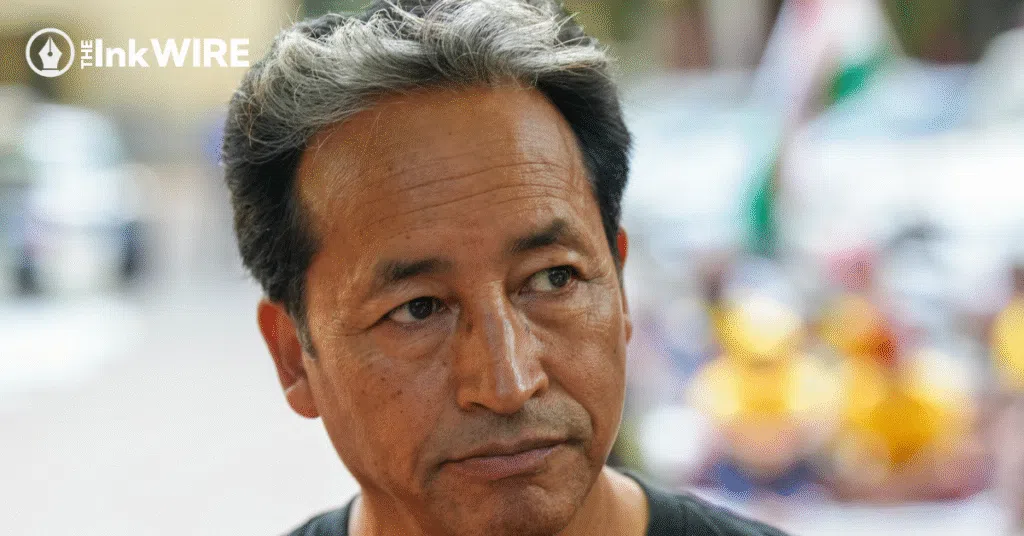
Activist Sonam Wangchuk finds himself detained. This action follows days of intense turmoil. Consequently, the Ladakh protest today has reached a boiling point. Authorities in Leh imposed a strict curfew. Police and paramilitary forces are enforcing this order. At least 50 people have been detained amid the crackdown. The situation escalated after the central government blamed Wangchuk. It holds him responsible for recent violent clashes. These clashes tragically left four people dead. Therefore, the entire region remains on edge. The air is thick with tension and uncertainty.
An Activist’s Arrest, A Movement’s Test
Ladakh Police arrested Sonam Wangchuk on Friday. The arrest marks a major development in the ongoing crisis. Significantly, it comes just two days after the region saw its worst violence in decades. Protests demanding statehood turned into widespread, destructive clashes. The government now accuses Wangchuk of inciting the mob. Furthermore, they claim his speeches were deliberately “provocative.” Officials point specifically to his references to Arab Spring-style protests. They believe this rhetoric fueled the public’s anger.
However, Wangchuk has consistently denied these serious allegations. He maintains that he always called for peace and restraint. Before his arrest, he made his position clear. He stated he would be “happy to be arrested anytime for this cause.” This highlights his deep commitment to the movement. In addition, the Ministry of Home Affairs took action against his NGO. It cancelled the Foreign Contribution (Regulation) Act license. This license belonged to the Students Educational and Cultural Movement of Ladakh (SECMOL). The government cited alleged financial irregularities as the reason. This move is seen by many as a way to pressure the activist.
“Instead of blaming activists who are peacefully protesting, the authorities should exercise restraint and impartially investigate and punish those responsible for violence.” Wangchuk
Curfew and Crackdown Grip Leh
The historic streets of Leh are now eerily quiet but tense. A stringent curfew is in effect across the entire region. Consequently, security forces patrol amid shuttered shops and businesses. This drastic measure aims to prevent any further unrest. The crackdown followed violent confrontations on Wednesday. Protesters had clashed fiercely with police forces. This led to a truly tragic outcome for the community. Four people were killed during the chaos. Moreover, over 50 others were injured, including security personnel.
The unrest caused significant and widespread damage. Protesters reportedly set fire to a local office of the Bharatiya Janata Party (BJP). The events mark a severe and dangerous escalation. The demonstrations had been ongoing for months. The Ladakh protest today has transformed dramatically. It shifted from peaceful marches into a highly volatile situation. To restore order, authorities have detained at least 50 individuals. The government is working urgently to control the escalating crisis. In fact, New Delhi has even dispatched a ‘special envoy’ to help resolve the situation.
Deep-Rooted Demands for Regional Autonomy
The current Ladakh protest today is not a sudden outburst of anger. Instead, it stems from long-standing and deep-rooted demands. People in Ladakh have been protesting since 2021. They have two primary and non-negotiable goals. First, they seek the granting of full statehood for Ladakh. Second, they demand inclusion in the Sixth Schedule of the Indian Constitution. This special status would grant the region significant autonomy. It provides powerful safeguards for tribal lands and unique culture. Moreover, it ensures job and land quotas for local people. These protections are considered vital for their future.
Ladakh’s administrative status has long been a point of contention. It was once part of the state of Jammu and Kashmir. Then, in 2019, the central government revoked the state’s special status. It subsequently split the region into two separate union territories. Ladakh became a centrally governed territory without a legislature. Initially, this move was welcomed by many in the Buddhist-majority Leh district. They had long sought separation from Kashmir. However, the lack of an elected assembly and other safeguards led to widespread frustration. Now, both Leh and the Muslim-majority Kargil district are united. They jointly demand constitutional protections for their land and identity. The ongoing Ladakh protest today reflects this powerful and united front.
Government’s Response and the Unclear Path Forward
The central government views the situation quite differently. It has squarely blamed Sonam Wangchuk for the recent violence. The Home Ministry stated he “misled” people with provocative references. Despite this, officials insist that dialogue remains the best path forward. A High-Powered Committee is already in talks with Ladakhi groups. The government believes this forum can effectively address the region’s aspirations. It urges protesters to engage in constructive dialogue. This approach, they feel, will resolve all issues. The Ladakh protest today complicates these talks.
In response to the violence, Lieutenant Governor Kavinder Gupta held a security review meeting. He called for heightened vigilance to maintain peace and order. Yet, the arrest of a key activist complicates the situation immensely. Wangchuk himself had warned that his arrest might only increase awareness. He believes it will broadcast Ladakh’s demands to a wider audience. He argued that blaming activists will not solve the underlying issues. The core of the problem is the deep frustration among Ladakh’s youth. They worry about jobs and their future. The Ladakh protest today is a symptom of this deep-seated anxiety.
The situation remains highly fluid and unpredictable. The detention of Sonam Wangchuk, a Ramon Magsaysay award winner, has drawn national attention. The path to resolution is completely unclear. Both sides are deeply entrenched in their positions. The people of Ladakh continue their fight. They seek what they see as their right to self-determination. Meanwhile, the government prioritizes maintaining law and order above all. Finding a middle ground will require immense wisdom and meaningful dialogue, not repressive tactics. Ultimately, the future of this strategically important Himalayan region hangs in the balance. The ongoing Ladakh protest today will undoubtedly shape its destiny for years to come.